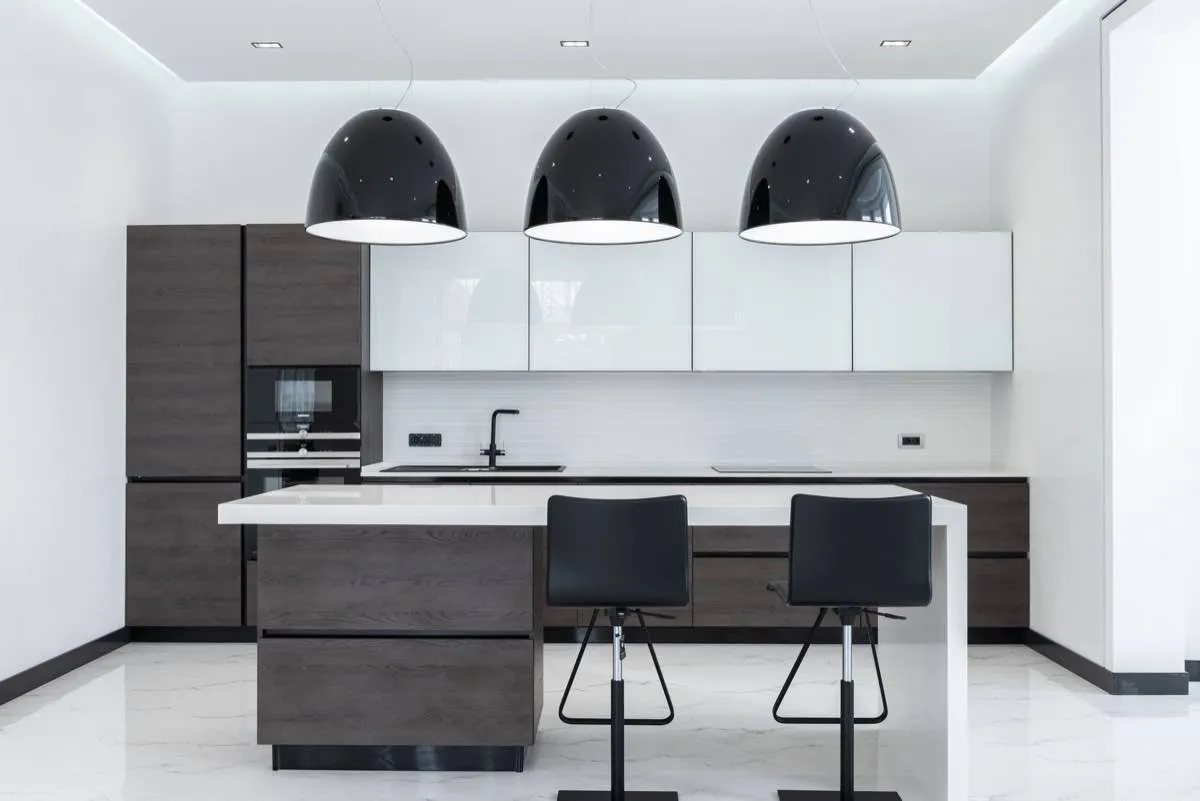
Matte black and brushed brass are what's selling, satin nickel is what actually lives in most kitchens, and hardware is the cheapest way to change how a kitchen reads — roughly $150 to $600 and one afternoon. If you're going to obsess over one small decision in a kitchen, this is a good one to pick, because it's reversible.
It's also the decision people get wrong in a very specific and consistent way: they buy hardware that's too small. A 3-inch pull on a 36-inch drawer looks like a doorbell on a barn.
The finishes, and how they actually age
| Finish | How it wears | Fingerprints | Honest read |
|---|---|---|---|
| Satin / brushed nickel | Very well. Hides everything | Barely shows | The safe volume choice. Goes with anything |
| Matte black | Well, but can show scuffs on cheap coatings | Shows oils on the flat black finishes | Current and strong. Buy quality or it chalks |
| Brushed / satin brass | Very well | Low | Warm, current, and forgiving |
| Unlacquered brass | Patinas deliberately over years | n/a, that's the point | Beautiful if you want a living finish. Not for everyone |
| Polished chrome | Excellent, essentially permanent | Shows every one | Migrated to bathrooms. Fine, just less current in kitchens |
| Oil-rubbed bronze | Wears through to brass at the grip | Low | Reads clearly like a specific past decade |
| Stainless steel | Excellent | Moderate | Neutral, slightly commercial |
Two practical notes. Unlacquered brass changes — it starts bright and darkens unevenly wherever hands touch it, and people either love that or return it in month three. And matte black quality varies enormously; a cheap powder-coat will scuff at the fingertips and a good one won't, and you cannot tell from a photo. Order one sample before you order forty.
Sizing: the part that actually matters
Trends move. Proportion doesn't.
- The one-third rule. A pull should run roughly a third of the drawer front's width. 12-inch drawer, 4-inch pull. 24-inch drawer, 8-inch. 36-inch drawer, 12-inch, or two 6-inch pulls spaced evenly.
- Common center-to-center sizes: 3 inch (76 mm), 96 mm, 128 mm, 160 mm, 192 mm, 224 mm. Note that 3 inch and 96 mm are close but not identical, which matters if you're reusing existing holes.
- Doors take a 3-inch or 96 mm pull, or a 1.25 to 1.5 inch knob.
- Appliance pulls for the fridge and dishwasher panel run 12 to 18 inches and are a different, heavier product.
- Placement: pulls horizontal and centered on drawers, vertical on doors with the bottom of the pull roughly aligned with the top rail of the lower cabinets.
If you take nothing else from this: go one size larger than feels right in the store. Hardware always looks bigger in your hand than it does on a wall of cabinets.
What dates a kitchen, and what doesn't
Dated is rarely about the finish. It's about the shape.
Ages well: simple bar pulls, plain cup pulls, round knobs, and anything with no decoration. These have been made continuously for a century and will be made for another one.
Ages poorly: heavily scrolled or ornate castings, twisted rope detailing, hammered or distressed textures, and anything with a very specific silhouette. Those read as the moment they were popular, permanently.
The good news is that this is the one kitchen element you can change on a whim. Doors, counters, and layout are commitments. Hardware is an afternoon.
Mixing metals without it looking accidental
The rule that works: pick a temperature, then vary the finish within it.
Warm — brass, bronze, matte black, warm wood. Cool — nickel, chrome, stainless, cool gray. Matte black is the useful one, because it plays as a neutral in both directions.
A brass faucet with brass cabinet hardware and brass lighting reads as one deliberate choice. A brass faucet with chrome cabinet pulls six inches away reads as two people who never spoke. Two finishes are fine. Three is where it gets hard, and if you're doing three, one of them should be black.
Our one strong opinion
Buy the hardware before you finalize the cabinet finish, not after.
Everyone does it the other way around, and it's backwards. The cabinets are the expensive, slow, custom part with an 8-week lead time. Hardware ships in three days and comes in a thousand options. Choose the two or three pieces of hardware you genuinely love, then pick a cabinet color that flatters them.
Doing it in the usual order means you commit $18,000 to a finish and then spend two months trying to find a pull that doesn't fight it. We've watched people order sample handles four separate times because the paint color was already sprayed.
Replacing hardware yourself, properly
This is a real DIY job and it does not need a contractor. It needs a template.
- Measure the existing holes center to center before buying anything. If your current hardware is 3 inch and you buy 96 mm, the holes will be 1.4 mm off and every screw will fight you.
- Buy a hardware jig for $15 to $30. It clamps to the door or drawer and puts every hole in the same place. Freehanding forty holes with a tape measure ends the way you'd expect.
- Drill from the front, with a backer block clamped behind, so any tear-out happens on the inside face.
- Check screw length. 8-32 in the US, M4 on imported hardware, and they will not interchange. Standard 1-inch screws suit a 3/4-inch door; add a backplate and you need longer ones.
- New holes over old ones: if you're changing spacing, fill the old holes with a two-part wood filler, not spackle, then touch up. On a painted door this hides completely. On stained wood it will be visible, which is a reason to keep the existing spacing.
Total cost for 40 pieces of mainstream hardware plus a jig: roughly $200 to $400. Total time: an afternoon with a podcast on.
When to skip it entirely
Plainly: if your existing hardware is a simple shape in a neutral finish and functioning fine, leave it alone. Simple satin nickel bar pulls from 2011 look almost exactly like simple satin nickel bar pulls from this year. Nobody is looking at them, including you, until an internet article suggests you should.
And if the actual complaint is that a handle is loose or a door sags, that's a screwdriver, not a shopping trip. Concealed hinges have adjustment screws for depth, height, and side-to-side, and ten minutes with them fixes a door you've been mildly annoyed by for years. The soft-close side of that conversation is in are soft-close cabinets worth it.
Bottom line
Buy hardware bigger than feels right, keep the shape simple, stay within one temperature family, and buy a jig. Choose it before the cabinet finish, not after. And if what you have is plain and works, keep your money.
Allen Elite Custom Cabinets builds custom kitchen cabinets, does refacing where the boxes are sound, and builds custom built-ins across Allen and Collin County — and we'll happily talk hardware and door style with you before anyone talks price. Call (833) 853-7549, or see how door styles change the look in Shaker vs flat panel cabinets.
Ready for a free quote in Allen?
Allen Elite Custom Cabinets — free estimate, clear scope, no pressure. Use the form on this page or jump to the homepage quote.
Related services in Allen
Allen Elite Custom Cabinets money pages — go straight to the service you need.
- Custom Kitchen Cabinets →
Pull one drawer completely out of an Allen kitchen framed between 2002 and 2014 and the whole story is visible in ten seconds. Particleboard sides, a thin bottom panel floating in a groove, and an epoxy-coated side-mount slide rated for about forty pounds.
- Built-In Cabinetry →
The two-story family room is the signature of Allen's 2000s plans, and it is the room built-ins exist for. Twenty feet of wall above the fireplace, a pair of shallow recesses flanking it, and nowhere in the whole space to put a book.
- Cabinet Refacing →
Refacing means keeping the boxes and changing the doors, the drawer fronts and the visible skin. Whether it is worth doing in Allen turns on one question asked at the cabinet, not on the phone.
- Bathroom Vanities →
The builder's primary-bath vanity in Allen is nearly always the same object. A sixty or seventy-two inch box standing thirty and a half inches tall, carrying a cultured marble top with the bowls cast into the deck as one piece.
- Closet Systems →
Every production house in Allen was handed over with the same closet. One coated-wire shelf with a rod welded into it, screwed to drywall clips at sixty-six inches, and nothing else in the room.
Frequently asked questions
What cabinet hardware finish is most popular right now?
Matte black and unlacquered or brushed brass lead most showrooms, with satin nickel still the quiet volume leader because it hides fingerprints and matches almost everything. Polished chrome has faded in kitchens and stayed in bathrooms. Oil-rubbed bronze reads distinctly like the 2000s to most eyes now.
How long should cabinet pulls be?
The common rule of thumb is a pull roughly one third the width of the drawer front. On a 30-inch drawer that means about a 10-inch pull, or two shorter pulls spaced evenly. On doors, a 3-inch or 96 mm pull suits most standard door widths. Undersized hardware is the single most common mistake.
Should I use knobs or pulls?
The traditional split is knobs on doors and pulls on drawers, and it still looks right. The current preference leans toward pulls everywhere, because they're easier to grab with wet or full hands. Mixing is fine as long as the finish matches and the sizing is deliberate.
Does cabinet hardware have to match the faucet?
No, and matching everything exactly tends to look flat. Coordinating within two finish families is the usual approach: a warm brass on the cabinets with a warm brass or matte black faucet, or a cool nickel with cool tones elsewhere. What looks wrong is a warm and a cool finish sitting inches apart.
What is the standard cabinet hardware screw size?
8-32 machine screws in the United States and M4 on imported hardware, and they are not interchangeable. Most pulls ship with 1-inch screws, which is right for a 3/4-inch door. Thicker doors or added backplates need longer screws, sold separately in most hardware aisles.
How much does it cost to replace all the cabinet hardware in a kitchen?
Handles run about $3 to $15 each for mainstream hardware and $20 to $60 for designer or solid brass lines. A typical kitchen with 30 doors and 10 drawers needs 40 pieces, so roughly $150 to $600 in parts. It's a DIY job for one afternoon if you use a template.
Local context
How this applies in Allen, TX
Every article here is written from cabinet work done in Allen and Collin County, so the numbers reflect local labour, permit and material costs rather than a national average. Your own job can land either side of them depending on access, the condition of what is already there, and the materials you pick — furniture-grade plywood carcasses, dadoed and glued box joints, five-piece painted MDF door panels.
The way to turn any of this into a real answer is to have someone look at your actual situation. The free estimate is free, itemized and written down, with no deposit and no obligation. Call (833) 853-7549 or start on the Allen Elite Custom Cabinets homepage.
Areas Allen Elite Custom Cabinets covers
Allen first, then the surrounding communities of Collin County. Each has its own page with local detail rather than a copy of this one:
- Plano, TX — Collin County, population 285,494
- Frisco, TX — Collin and Denton Counties, population 200,509
- McKinney, TX — Collin County, population 195,308
- Garland, TX — Dallas County, population 246,018
- Richardson, TX — Dallas and Collin Counties, population 119,469
- Wylie, TX — Collin County, population 57,526
Or jump to the full list of Allen services.
More from the Allen Elite Custom Cabinets blog
- Kitchen Cabinet Cost in Allen: Real Ranges for 2026
Kitchen cabinets run about $100 to $1,200 per linear foot depending on tier. Honest stock, semi-custom, and custom ranges for Allen, TX homes.
- Custom Built-In Cabinets: Allen Per-Foot Costs
Custom built-in cabinets in Allen, TX — entertainment walls, offices, mudrooms and window seats, real per-foot costs, and when furniture is smarter.
- Cabinet Refacing vs Replacing (Allen Guide)
Reface if the boxes are solid and the layout works; replace if they're damaged or the layout changes. Real costs and timelines for Allen, TX.
The Allen Elite Custom Cabinets Team
cabinet specialists serving Allen, TX
Written by the Allen Elite Custom Cabinets team — insured cabinet pros with 15+ years serving Allen, TX and the surrounding area.